
Technology and Politics (POLS/COMM 419)
Instructor information
Dr. José Marichal (he/him/his)
Professor of Political Science
Office Hours: SWEN 228: MWF 2:00 to 3:00; Zoom Tue 12:00-2:00
Contact: marichal@callutheran.edu
Time and Place: (HUM) 110
About the Instructor
I am a professor of political science at California Lutheran University. I specialize in studying the role that algorithms and AI play in restructuring social and political institutions. I am the author of "You Must Become an Algorithmic Problem" that came out in 2025 with Bristol University Press (UK). The book explores the unwritten social contract we have with the algorithms that shape what we see, hear and think. I have a number of projects with collaborators looking at how social media shapes political discourse. My next project is entitled "Machine Liberalism." It looks at how algorithms and AI are changing our expectations of liberal democracy. That book will come out with Intellect Books/University of Chicago Press in 2027. I am also the director of Civic AI initiatives at California Lutheran University.
Course Description
In a book that I'm working on, I argue that we live in an era of Machine Liberalism—a new social contract where citizens trade their autonomy for the promise of algorithmic prediction and convenience. This course investigates how the tools of data collection (social media, smart devices) and analysis (AI, machine learning) are fundamentally reshaping the "Liberal Subject." Historically, liberal democracy assumed citizens were autonomous agents capable of reasonableness. Today, algorithms optimize us for predictability and preemption, challenging our capacity for self-government.
Drawing from Political Science, Communication, Information Science, Sociology, English, Philosophy and Law, we will explore how this shift from "Rights" to "Optimization" impacts everything from free speech and labor to intimacy and security.
This course operates as a "Living Syllabus." We will engage directly with the leading scholars in the field—co-affiliates of the Center for Information, Technology, and Public Life (CITAP) at the University of North Carolina at Chapel Hill— many of whom will join us weekly via a Friday Zoom session to discuss their work with us. Furthermore, the course will function as a Civic AI Project, where we will use computational tools to identify a local problem, gather data and opinion, identify best practices, analyze data and recommend solutions... all using AI tools. Our ultimate goal is to determine whether AI can be reclaimed for democratic and inclusive purposes and to reflect on our experience using these tools for "good."
Course Policies
In creating a learning environment in which diversity is embraced and contradictions are explored, it is important that all students feel safe, respected, and free to address the complex subjects and feelings that may arise as a result of readings and discussions. Therefore, it is imperative that all of us treat each topic and each other with maturity and respect. Your contributions to class discussions will be important and valued aspects of this course. If you are uncomfortable with frank and open discussions, then you may want to reconsider taking this course.
Throughout this course, we agree that “what’s said in the classroom, stays in the classroom”, and this holds true, even if some of class activities are online/via Zoom: students are not permitted to record or otherwise share in-person or online class sessions or interactions with faculty, guest speakers and/or each other. Your continued enrollment in this course signifies your agreement to abide by the terms and conditions of this syllabus and of all course requirements. This syllabus is subject to change. Every effort will be made to alert students to changes that occur in a timely manner: modifications will be discussed in Zoom class session and/or via Canvas announcement/email: you are required to regularly check your CLU email account and the course Canvas page.
Mission and Program Learning Objectives
University: Communication (Written & Oral); Information Literacy; Creative &
Critical Thinking; Identity & Values; Interpersonal & Teamwork Skills, Cross-Cultural
Competency
POLS Dept.: Critical Thinking, Civic Engagement
Graduation Requirements fulfilled by this course: fulfills CORE 21 Writing
Intensive requirements; count as upper-division elective for the POLS or COMM major
Course Requirements
Students join class on time, prepared to learn (i.e., be ready to focus on class-related activities). If you are unable to participate in class, due to illness or other reasons, then review the discussion slides and any other class materials which will be uploaded/shared via Canvas after each session. Most key concepts needed to complete course assignments will be noted in the discussion slides and/or shared online via Canvas.
Talking, working, and thinking with others are key to this course. We will discuss controversial subjects. I encourage expressions of opinions, but our class (including online interactions) will be a safe place. That is to say, we will all treat each other in a respectful manner. Rude interruptions and personal attacks (including racial, gender, sexuality, etc. slurs) will not be tolerated. You may not always be comfortable with topics, and you are not expected to approve of all that we discuss.
If a professor or a guest-speaker find your behavior to be disruptive or disrespectful – to us, to other students or to guest-speakers – then you may have to leave the class session.
Readings and viewings for the day need to be completed prior to class start-time: class activities, discussions, etc. will primarily draw upon assigned material. Bring detailed notes on readings/viewings to each class session.
Statement on Academic Honesty
The educational programs of California Lutheran University are designed and dedicated to achieve academic excellence, honesty and integrity at every level of student life. Part of CLU’s dedication to academic excellence is our commitment to academic honesty. Students, faculty, staff and administration share the responsibility for maintaining high levels of scholarship on campus. Any behavior or act which might be defined as “deceitful” or “dishonest” will meet with appropriate disciplinary sanctions, including dismissal from the University, suspension, grade F in a course or various forms of academic probation. Policies and procedures regarding academic honesty are contained in the faculty and student handbooks. Plagiarism, cheating, unethical computer use and facilitation of academic dishonest are examples of behavior which will result in disciplinary sanctions. Plagiarism includes, but is not limited to:
- word for word copying without using quotation marks or presenting the work as yours
- not citing quoted material – students must cite sources for any information that is not either the result of original research or common knowledge
- using ideas or work of others without acknowledgement (including AI-generated text)
All assignments and exams must be submitted on time online as a PDF attachment (via Canvas link under that week). Missed assignments or exams will be marked down as zeroes. Late assignments/exams will be graded when documentation of an emergency is provided. During this pandemic, Cal Lutheran has asked professors to determine the best ways for students to continue with coursework when needing to miss class due to illness or quarantine/isolation.
Follow all public health protocol: see https://www.callutheran.edu/know/.
Prior to due date/time, submit assignments via course Canvas page; if Canvas is having technical difficulties, then email it to me as PDF attachment. Assignments must be typed, double-spaced, 12-point (legible) font, with 1-inch margins all around, spell-checked, grammar-checked, pages numbered, and correct citation/reference format (APA Style; no abstracts required).
Disability Statement
California Lutheran University is committed to providing reasonable accommodations in compliance with ADA of 1990 and Section 504 of the Rehabilitation Act of 1973 to students with documented disabilities. If requesting accommodations for this course, then register with Disability Support Service: contact DSS@callutheran.edu with any questions, and I will review Letters of Accommodation.
Sexual Misconduct
California Lutheran University does not tolerate any degree of sexual misconduct on or off-campus. We encourage you to report if you know of, or have been the victim of, sexual harassment, misconduct, and/or assault. If you report to a faculty member, then they must notify the Title IX Coordinator about the incident.
AI Policy
Course Assignments: Technology & Politics (Spring 2026)
Total Points: 100
- Part 1: The "Machine Liberalism" Reflexive Journal (60 Points)
- Part 2: The Civic AI Project: Algorithmically Assisted Policy Design (40 Points)
Part 1: The "Machine Liberalism" Reflexive Journal (60 Points)
Objective: To connect the theoretical concepts of each Unit to the real-world implications for democratic life.
Format: For each of the 6 Units, you will submit a 2–3 page reflection paper. This is not a summary of the readings. It is an application of the theory.
The Prompts: Instead of a generic summary, answer the specific thematic question for each Unit below. Your goal is to connect the broad theoretical argument to the specific readings/discussions of the week.
- Unit 1 (Theory): How does the shift from "Rights" to "Design" (or Optimization) fundamentally alter the social contract between the citizen and the state?
- Unit 2 (Economy): In what ways does the "attention economy" or the demand for "metrics" reshape our understanding of labor—specifically the labor of specific self-presentation?
- Unit 3 (Epistemic): How does the reliance on "machine certainty" or algorithmic prediction change what counts as "truth" or "expertise" in public discourse?
- Unit 4 (Security): How does the logic of "preemption" (stopping risks before they happen) challenge traditional notions of justice, due process, or innocence?
- Unit 5 (Social): How do algorithmic structures mediate our intimate relationships or community bonds, and what specific form of "sociality" is produced by these tools?
- Unit 6 (Resistance): Is meaningful resistance to "Machine Liberalism" possible through individual action (opting out), or does it require a structural/collective response? What would that look like?
"AI-Proofing" Requirement: To ensure this work reflects your specific engagement with our unique class dialogues, you must include at least five specific references to points made during our class discussions or Friday Zoom sessions (not just summaries of the readings). You must bold these five references in your text. Papers that do not include these bolded, specific in-class references will not be accepted.
Grading Criteria (10 Points Each):
- Evidence of Engagement (4 pts): Does the paper include at least five bolded, specific references to class/Zoom discussions that demonstrate genuine presence and listening?
- Theoretical Synthesis (3 pts): Does it meaningfully connect these discussions to the assigned readings?
- Application & Clarity (3 pts): Does it apply the theory to a concrete example (a law, app, or event) in a clear, well-structured argument?
Due Dates (Mondays @ 11:59pm):
- Unit 1 (Theory): Due Monday, Feb 16
- Unit 2 (Economy): Due Monday, Mar 16
- Unit 3 (Epistemic): Due Monday, Apr 13
- Unit 4 (Security): Due Monday, May 4
- Unit 5 (Social): Due Monday, May 11
- Unit 6 (Resistance): Due Wednesday, May 13 (with Final Audit)
Part 2: Civic AI Project: Agentic Policy Entrepreneurship (40 Points)
Format: Individual Project
Objective: "Vibe-Solving" for the Public Sector: Balancing the Possible and the Political.
In the public sector, a "Policy Entrepreneur" faces a dual challenge. You must design a solution that is politically survivable (it won't be killed by established interests), but also imaginative enough to break the status quo.
The "Manager" Mindset: You will use AI tools (ChatGPT, Claude, Gemini, etc.) as your "Policy Lab Staff." You will delegate research to them to find what is working elsewhere ("Best Practices"), while also using them to simulate the political opposition ("Red Teaming"). Your goal is to find the "Politics of the Possible"—the sweet spot where innovation meets feasibility.
Phase 1: The Discovery & Friction Audit (10 Points)
Due: Wednesday, Apr 1
- Step A: Identify the "Wicked Problem". Choose a local/regional challenge (e.g., Housing Zoning, Transit Expansion, AI Surveillance in Schools).
- Step B: The "Global Search" (Delegate the Inspiration).
Use the Global Policy
Analyst to escape local myopia.
- Strategy: Launch the Global Policy Analyst and input your Wicked Problem. It will simulate 10 regional experts to find global success stories.
- Key Question: Which of the 10 regional perspectives offered the most surprising or effective solution to your problem?
- Step C: Map the Stakeholders. Now, pivot to local
reality. Use the Stakeholder Policy
Analyst to identify who benefits
from the current failure.
- Constraint: Generate a "Friction Map." Who are the veto players (Unions, HOAs, Bureaucracies)? Why will they hate the "best practices" you found in Step B?
- Deliverable: A "Possibility & Friction Brief" (Best Practices vs. Local Reality).
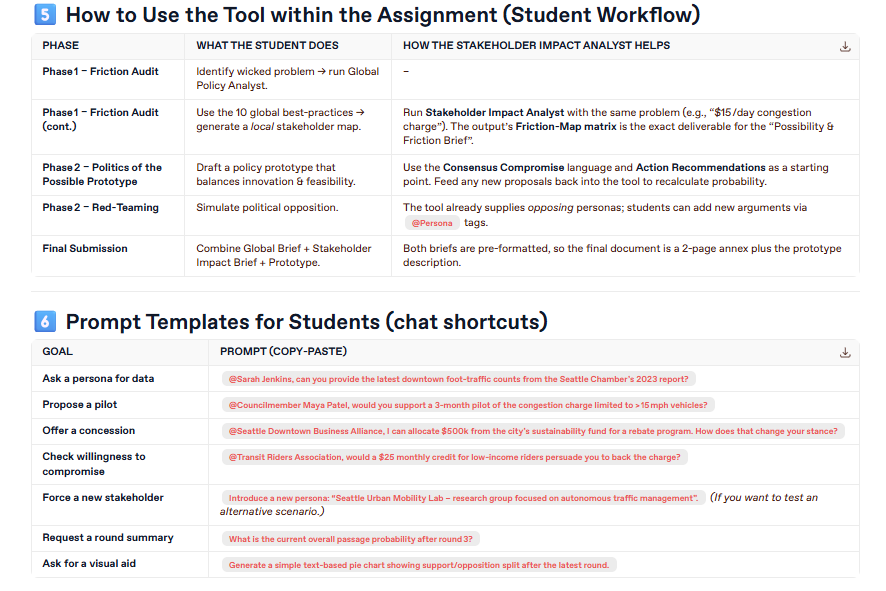
Phase 2: The "Politics of the Possible" Prototype (15 Points)
Due: Wednesday, Apr 22
- Step A: The Synthesis. You have a cool idea (from Step B) and a hostile environment (from Step C). Your job is to design a policy that keeps the core innovation while neutralizing the opposition.
- Step B: Rapid Prototyping. Use the Policy
Prototyper to generate the
"Minimum Viable Policy":
- The Artifact: A mock App, Ordinance, or Budget.
- The Coalition Strategy: Use the AI to brainstorm "Sweeteners." How can you modify the policy to buy off the opposition *without* ruining the idea? (e.g., "If we automate X, can we guarantee job placement for the displaced union workers?")
- Step C: The Pivot Log. Document the evolution. "We started with Idea X (from Barcelona), but the AI 'Union Rep' persona hated it, so we pivoted to Idea Y."
- Deliverable: The Policy Artifact + The "Evolution Log."
Phase 3: The Reality Check & Reflection (15 Points)
Due: Wednesday, May 13 (Finals Week)
- Step A: The "Visionary & The Skeptic" Pitch. Pitch your
solution to a human. Ask them to wear two hats:
- The Skeptic: "Why will this fail?"
- The Visionary: "If this worked, how would it transform our community?"
- Step B: The Reflection Paper (3–4 Pages). Answer these
questions:
- The Possibility Gap: Did the AI help you find a solution you wouldn't have thought of (the "Politics of the Possible")? Or did it just recycle generic technocratic ideas?
- The Managerial Equation: Was the AI better at the "Creative Search" (Phase 1) or the "Political Strategy" (Phase 2)? Where did it fail?
- The Conclusion: Is "Vibe-Solving" a way to democratize policy innovation, or does it risk hallucinating solutions that detach us from the hard work of political organizing?
- Deliverable: Final Reflection Paper + Group Presentation Slides.
Attendance Policy
Regular attendance participation in class sessions is vital to course learning experiences. You are expected to attend all scheduled class sessions. If illness or emergency results in absence, then email me as soon as possible; on Canvas, review each session’s lecture slides (key course content covered that day). I will take a roll call during class sessions. A few absences are anticipated during a semester, and you are responsible for material covered during any class you miss. However, if you miss more than five classes for unexcused reasons, you cannot pass the course.
Grading
Your final grade for the semester will based on total accumulated points as follows:
- 92 – 100 A
- 90 – 91 A-
- 88 – 89 B+
- 82 – 87 B
- 80 – 81 B-
- 78 – 79 C+
- 72 – 77 C
- 70 – 71 C-
- 68 – 69 D+
- 62 – 67 D
- 60 – 61 D-
- 59 or less F
Course Evaluations: Your feedback helps shape this course. All course evaluations are conducted online; you will receive email reminding you when evaluation website is open.
Course Materials
Required Texts, Readings & Viewings: All readings on syllabus or on Canvas
The Course Schedule lists each day’s topics, readings and viewings (to be completed prior to that day’s class), and assignments due for each day. If a day is designated as Check-in Meetings, Exam or Guest Speaker, then our in-person class session will be replaced by Zoom session.
COURSE SCHEDULE: may be adjusted to meet course objectives or align with public health measures. Assigned readings and viewings noted in schedule are to be read/viewed before class session, and make sure to bring reading materials and notes to class.
REQUIRED TEXTS: All Online (click on the link under the assigned day)
AI-Assisted Reading Tool: NotebookLM
To help you grasp the complex concepts in our readings, I encourage the responsible use of Google NotebookLM. This tool allows you to upload our course PDFs and ask questions, generate summaries, and even create audio overviews to check your understanding.
How to use it responsibly:
- Official Guide: How to use NotebookLM
- Video Tutorial: Using NotebookLM for Study (Tiago Forte)
- FSU Guide: Ethical and Effective Use
Remember: Use this to deepen your understanding, not to replace reading. You will still need to cite specific page numbers and quotes in your assignments that AI summaries might miss.
Schedule
Unit 1: The Theoretical Shift - From Rights to Design
Historically, Liberalism assumed the citizen was an autonomous, rights-bearing subject—an agent capable of reason, choice, and self-definition. Today, the Digital Subject is defined not by autonomy, but by legibility and predictability. In this unit, we explore how the "Socio-Technical Contract" has rewritten the rules of democratic life: moving from a system that protects rights (speech, privacy) to a system that engineers "Ontological Integrity" (safety from disruption).
Dr. Charles Hall (Pepperdine) examines the intersection of religious identity and political ideology. Event Details
Unit 2: The Economic Shift
We have moved from an economy of Production to an economy of Optimization. In this unit, we examine how the logic of AdTech and performance metrics has colonized our political identity. The citizen is no longer a participant in the public sphere; they are a "Brand" managing their reputation in an attention economy. We explore how labor is disciplined by metrics and how political movements are packaged as lifestyle brands.
Dr. Marichal discusses his new book on the unspoken agreement with tech companies and its consequences for liberal democracy.
DUE: Unit 1 (Theory) Reflexive Journal (Feb 16)
"How does the shift from 'Rights' to 'Design' (or Optimization) fundamentally alter the social contract between the citizen and the state?"
- Reece Peck, "Branding Conservatism" (Fox Populism)
- A.J. Bauer, "Why Conservatives Can’t Stop Acquiring Media Companies"
- Extra Credit
- Notebook LM
Cases We'll Discuss in Class:
With Dr. John Garcia. Focus on self-reliance, empowerment, and preparedness for students handling their own finances.
- Lauren Bridges, "Toxic Clouds and Dirty Data"
- From AI to PC: Reframing AI as Parasitic Computation — To access the article click on the PDF link on the left hand side of the page. The PDF is an edited volume. I only want you to read pages 20 to 23.
- NotebookLM
Instead, watch the livestream of Disputatio on Artificial Intelligence from Pacific Lutheran Theological Seminary in Berkeley.
Film screening of street artist JR's work turning communities inside out into social art installations.
Unit 3: The Epistemic Shift - Knowledge, Truth, and "Machine Certainty"
The Enlightenment project was built on the ideal of Explanation—knowing why something is true. The AI era replaces this with "Machine Certainty"—knowing that an answer is optimized, without understanding the mechanism. We explore the rise of "Epistemic Arrogance," where algorithms provide answers that feel authoritative but lack context. We look at how data is classified, how journalism is being retooled by generative AI, and how "Vibes" replace facts.
Launch the Rule Maker
Gem. We will use its Agentic Mixture of Experts logic to scour global
perspectives for cities that have solved your chosen "Wicked Problem."
Goal:
Identify 3 "Unlikely Success Stories" to reverse-engineer.
DUE: Unit 2 (Economy) Reflexive Journal (Mar 16)
"In what ways does the 'attention economy' or the demand for 'metrics' reshape our understanding of labor—specifically the labor of self-presentation?"
An evening of learning and skill-building with Jennifer Linde and Loretta Ross. Event Details
- Rachel Moran, "Changing Tides" (Transnational Information Disorder)
- Note: The Zine is in English starting on page 23.
- Slides
Review the Adversarial
Critique (Reviewer 2) generated by the Rule Maker Gem. Debate your proposal
against this persona to expose its weaknesses.
Goal: Generate the "Friction Map"
for Phase 1.
Roosevelt Montás, PhD, of Bard College will speak about the role of liberal education in democratic public life. Event Details
Meet future pre-law students, make connections, and learn how to get involved. Pizza/snacks will be served.
DUE: Participatory AI Lab Project Phase 1 (The Agentic Discovery)
Unit 4: The Security Shift - Preemption, Surveillance, and the Face
Liberal justice was traditionally based on Deterrence—punishing bad acts after they occurred. Machine Liberalism is based on Preemption—predicting risk before it happens. In this unit, we examine the rise of the "Security Mindset," where the state uses predictive policing, facial recognition, and deepfake analysis to manage populations. This shift erodes the presumption of innocence and transforms the citizen from a subject of rights into a subject of risk.
Dr. Alex Madva discusses how to connect personal choices to structural change regarding climate change, racism, and poverty.
DUE: Unit 3 (Epistemic) Reflexive Journal (Apr 13)
"How does the reliance on 'machine certainty' or algorithmic prediction change what counts as 'truth' or 'expertise' in public discourse?"
Your policy is good, but it's political
poison. We will use the AI to brainstorm "Coalition Sweeteners"—add-ons that buy off the
opposition without ruining the core idea.
Goal: Draft the "Minimum Viable
Policy" (Phase 2).
DUE: Participatory AI Lab Project Phase 2 (The 'Vibe' Prototype)
Unit 5: The Social Shift - Intimacy, Affect, and the Home
We are trading the friction of human Relationality (which requires vulnerability and shared fate) for the smoothness of Synthetic Relationship (which offers comfort and control). We explore how AI is reshaping intimacy—from "smart homes" that surveil us to platforms that police desire. What happens to human dignity when our primary social interactions are optimized for engagement rather than connection?
Unit 6: Technology and Solidarity - Refusal, Organizing, and the Future
If the "Algorithmic Contract" is broken, how do we renegotiate it? We move beyond the idea of "better regulation" (fixing the algorithm) to the idea of Refusal (rejecting the optimization). We explore how communities build solidarity, and conclude by asking how we can reclaim the "Right to be a Problem."
DUE: Unit 4 (Security) Reflexive Journal (May 4)
"How does the logic of 'preemption' (stopping risks before they happen) challenge traditional notions of justice, due process, or innocence?"
Live Pitch Practice. One student plays
the "Visionary" (selling the dream), the other plays the "Skeptic" (drilling the failure
points), while the AI generates live counter-arguments.
Goal: Finalize the
narrative for the Final Audit.
DUE: Unit 5 (Social) Reflexive Journal (May 11 - Mon)
"How do algorithmic structures mediate our intimate relationships or community bonds, and what specific form of 'sociality' is produced by these tools?"
DUE: Participatory AI Lab Project Phase 3 (Human Audit & Reflection)
DUE: Unit 6 (Resistance) Reflexive Journal
(no journal entry -- I'll double the highest of the scores from the five journal entries)